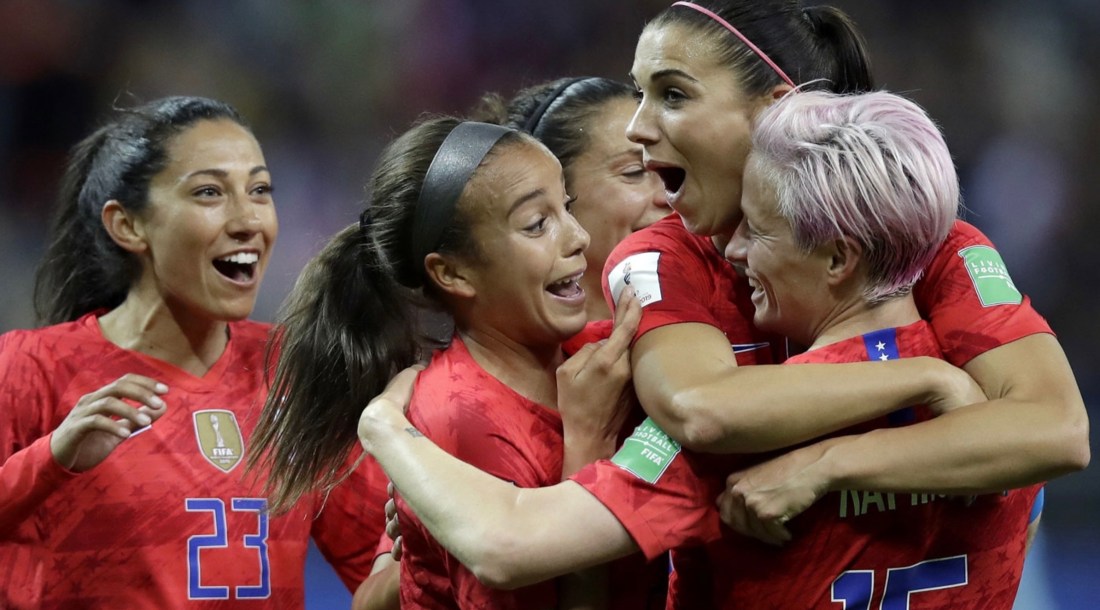
Alex Morgan celebrating one of her five goals against Thailand with her teammates.
One team is an international powerhouse who is looking to win their fourth World Cup. The other team has never won a World Cup and didn’t even qualify last time around. Guess who gets paid more? That’s right, the team who doesn’t even qualify. Oh, by the way, they’re men, in case you didn’t know already.
The U.S. Women’s National Soccer Team (USWNT) quickly went viral with their crushing defeat of the Thailand Women’s National Team in the first round of the World Cup Group play. They won 13-0, the largest deficit ever in a World Cup game. In this game alone, the USWNT scored more goals then the U.S. Men’s National Team (USMNT) has in their last three World Cups. The Men’s National Team has never won the World Cup, and the U.S. Women have won three, and are heavily favorited to win again this year. The men did not even qualify. So if the women are a much better team, why do they get paid significantly less?
On average, the USWNT gets paid 38 cents on the dollar when compared to the men. They also feel like they are provided with inferior working conditions. These two issues are the biggest reasons 28 players from the USWNT pool are suing the U.S. Soccer Federation. The lawsuit began in early March, with current U.S. stars Carli Lloyd, Alex Morgan, Megan Rapinoe, and Becky Sauerbrunn leading the way. In 2016, these four players, along with former USWNT player Hope Solo, filed an official complaint with the Equal Employment Opportunity Commission (EEOC). Last February, Lloyd, Morgan, Rapinoe, and Sauerbrunn received right-to-sue letters in the mail, which led them to where they are now. The women requested class-action status, which means that any member of the National Team since February 2015 would be able to join in on the lawsuit. The women’s lawsuit contained a 25-page filing including 41 official complaints. The full list of complaints can be found here: https://equalizersoccer.com/wp-content/uploads/2019/03/2019-03-08_Doc-1_Complaint-Receipt-No.pdf
One of the main counterarguments for the U.S. Soccer Federation is that the women got a higher percentage of revenue from World Cups that took place four and five years ago, 13% as opposed to the men’s 9%. But, if that is the main argument, then the women are in good shape because while they receive a higher percent, they actually receive significantly less money. In 2010, the men’s World Cup brought in $4 billion, all the participating men’s players would’ve received about $472,826, and the women brought in $73 million and each player received about $29,761, assuming that the money was divided evenly. It was recently revealed that the winning team for the Women’s World Cup will receive an additional $2 million, and Germany, last year’s Men’s World Cup winner, received $35 million to split.
To help close the current pay gap, LUNA Bar gave the USWNT $718,000. After they announced this, Adidas stated that they would be offering the same bonus incentives to the women as they were for the men. Although these are both very positive, the US Soccer Federation should not need to rely on big name companies to help close the pay gap between men and women.
The women technically earn a higher base salary than the men, at $72,000 per year. But, the men have more incentives than the women. The women only get bonuses if they win their international friendly games. However, the men get a bonus just for playing the game, and an even bigger one if they win. At the moment, the simplest solution would be to just offer the same base salary and incentives. This may not be the best solution for the long run, but it would sure be a start.
Written by Eliza Buerk
https://ftw.usatoday.com/2019/04/uswnt-equal-pay-luna-bar-us-soccer
https://www.theatlantic.com/business/archive/2016/06/when-pay-defies-performance/487103/

 Here to Play