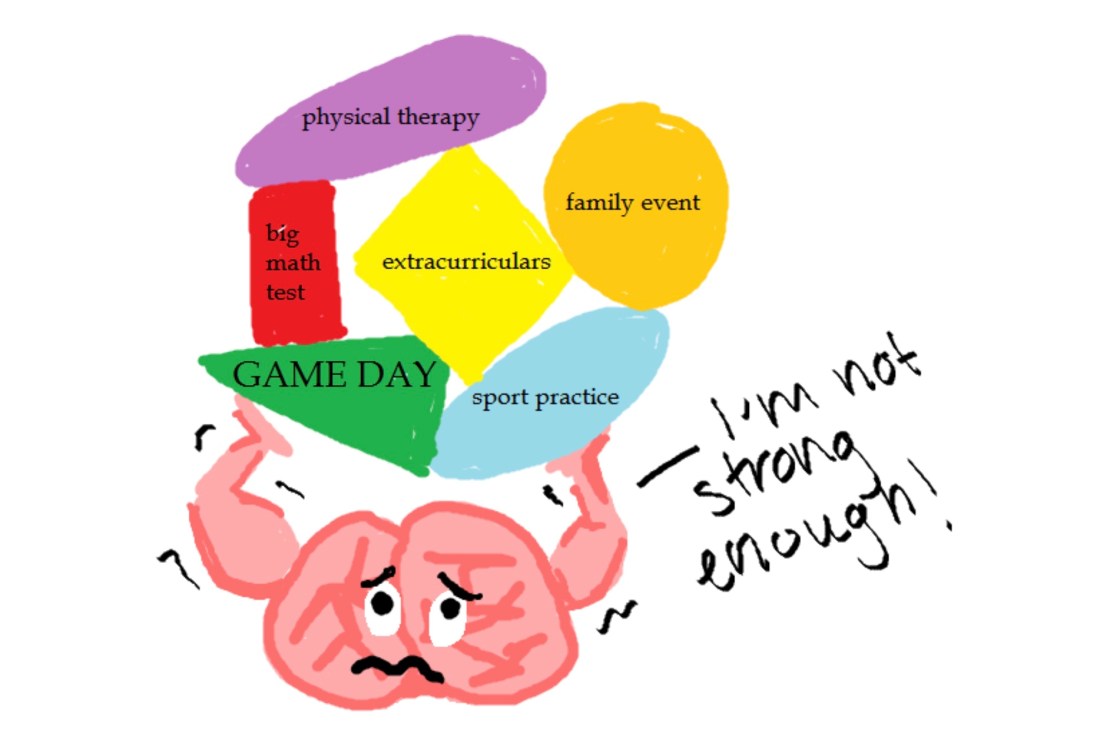
This image may seem childish at first, but for most athletes, it accurately depicts the stressors of their lives.
Every athlete has some sort of rival. Whether it is a teammate or team that you just can’t beat, or maybe even yourself. In society today, there is a stigma around mental health. No matter how much more we are trying to talk about it, there is and most likely always will be a stigma. But, it is even less talked about in athletes, especially adolescent athletes. There are many young athletes that are battling or have battled bouts of depression. A study done in 2015 said that many student-athletes report higher levels of negative emotional states than non-student-athlete adolescents. One main reason for this is because high schools have started to mimic the rigorous training methods and schedules of college sports. This is called the trickle-down effect. The training methods of professional sports have trickled-down from the pros to college, and now to high school. Marshall Mintz, a New Jersey–based sports psychologist who has worked with teenagers for 30 years, who was also associated with the 2015 study, said that “The biggest problem is sleep loss—all these kids are sleep-deprived, and this becomes a major contributor to anxiety and depression.”
Almost all serious athletes can vouch for this statement. As you get older, the practices get later and later. Practices that used to end at 7:30 now go until 9:00, which means you get home at 9:30, but only if the practice ends right on time, there is no traffic, the gym is close to your house, and you are walking out the door at 9:05. In reality, it will usually be closer to 9:45 or 10:00. For the athletes that have two practices back-to-back, they will have maybe thirty minutes between when they get home from school and when they leave for practice. So, you will have to do your homework after your practice. Then you will be done and showered by 11:00, on the early side. Get up the next day and repeat. Then, if you have morning workouts, that is a whole other story that we will not get into right now.
When athletes do start to struggle with mental health, they do not know who to talk to. We love our teammates and coaches, but we would not talk to them about it because we do not want them to view or treat us differently. We can’t talk to our parents, because they might say that we need to cut back on our practice hours. Then, we would feel like we are falling behind, which could be disastrous, especially if we are going over plays during practice time. High level college athletes have access to the best strength training coaches, the best this and the best that. But what they do not have access to is the best psychologists and mental health professionals. This makes it difficult for them to deal with their mental health, therefore causing a drop in performance. In the end, all we really need is sleep, sleep, and a little more sleep to be able to be fully functional, day in and day out.
A recent study done among 465 NCAA Division I athletes about depressive symptoms relative to sport and gender showed that female track and field athletes had the highest percentage, at an astounding 37%. The male track athletes had 25% for track. The lowest rates were male soccer and male lacrosse players. The survey was only done among male and female track and field athletes, lacrosse players, soccer players, and baseball/softball players, so it doesn’t include all sports. On average, the women had 11.5% higher depressive symptom rates relative to men.
So, to all the math teachers out there, quit assigning homework that is graded every. Single. Night. On behalf of all young students-athletes and students with after school activities, thank you.~
Written by Eliza Buerk

 Here to Play